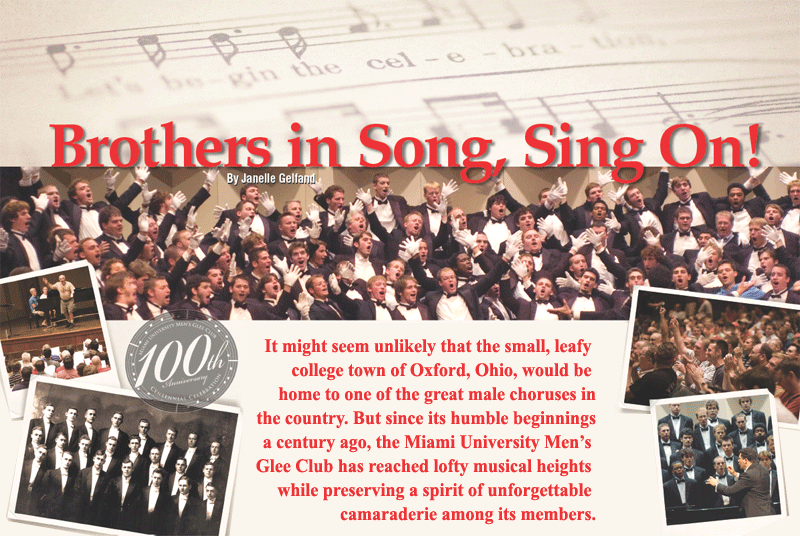
“It’s a camaraderie that continues for a lifetime,” says John “Doc” Wabrick, the Glee Club’s 12th director, who retired in 1988 after 24 years. “It’s the music that everybody gets into. So it becomes a feeling of one.”
Other U.S. collegiate choruses may be older, but Miami’s has the distinction of being one of the few a cappella male groups established at the behest of a university president. Almost immediately, it began touring extensively throughout Ohio and, soon, to the capitals of Europe.
Over the years, it has performed with the region’s finest orchestras such as the Cincinnati Symphony and Dayton Philharmonic, often combining with other Miami choral groups, and has appeared with luminaries such as opera star Beverly Sills and jazz legend Dave Brubeck. All the while, its social traditions of skits, serenades of women’s dorms, banquets, and the initiation “bash” have kept generations of students engaged and entertained.
It all started on a cold night in January of 1907 as Miami President Guy Potter Benton and a young instructor named Raymond Burke waited for a train. The president informed Burke that the school would retain him as assistant professor of geology. Then, because he had heard Burke was interested, he invited him to form a glee club.
After six months of rehearsals, the 21-member Miami University Men’s Glee Club presented its first program on Feb. 28, 1908, in the opening concert for Hall Auditorium (formerly Benton Hall). For the first time, Miami students heard their fight song, as well as new music for the Alma Mater, which Burke had composed in time for the occasion.
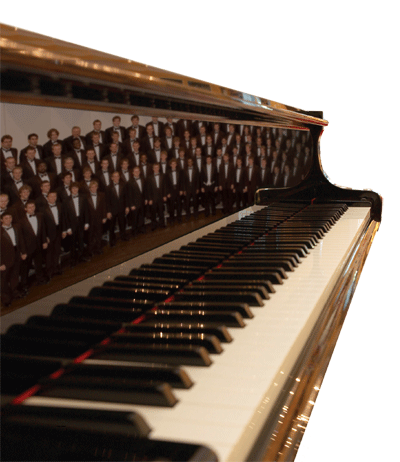 “Until then, students were singing the Alma Mater to the tune of ‘My Darling Clementine.’ So Miami is one of the few schools that has original music, and not a drinking song, for its Alma Mater,” says current director Ethan Sperry. “Until then, students were singing the Alma Mater to the tune of ‘My Darling Clementine.’ So Miami is one of the few schools that has original music, and not a drinking song, for its Alma Mater,” says current director Ethan Sperry.
It was an auspicious beginning.
If the original members were fraternity brothers, today’s 105 voices represent a cross section of the university.
“There’s no ‘kind.’ Your typical nerd, jock, fraternity guy, music major — it just runs the gamut,” says former member Dan Hayes ’05, who is producing a documentary about the group.
The first time Hayes, a Milwaukee native, saw the organization perform, he was bowled over by the traditional old Irish parting blessing, in which members hold hands, encircle the auditorium, and sing “May the road rise up to meet you.”
“This was the most incredibly beautiful thing I’ve ever heard. To see these guys holding hands, in our society today, it kind of puts you off. But I was like, I’ve got to be a part of this,” he says.
Jack Keegan, who came from Pittsburgh to Miami 30 years ago to be a botany instructor and greenhouse manager, joined and is still singing.
“There’s an acceptance there that is very neat, even for an old guy like me,” Keegan says. Rod Nimtz ’79 MA ’81, interim director of development and alumni outreach for Miami Middletown, joined as a student in the fall of ’77. He became accompanist two years later, serving for 12 years. The attraction for him was the extraordinary timbre of the all-male choir.
“There is an incredible sound, unlike any other,” Nimtz says.
From the beginning these men have been ambassadors for the university. Regional touring began as early as 1909 to such cities as Middletown, Piqua, Troy, Sidney, Dayton, and Cincinnati, with recruitment of students as its mission.
The 1920s and ’30s saw rapid growth. In the 1930s, the 32-member men’s ensemble was going down to Cincinnati for annual stints on WLW radio. Touring became more extensive. In 1927, the men set sail for 35 days in Britain, Belgium, France, and Germany, the first of 10 European tours. One of those was a 1969 tour with the Cincinnati Symphony Orchestra, as part of the Miami University A Cappella Singers (George Barron, director). A year earlier, they had performed — and recorded for Decca Gold — the world premiere of Brubeck’s first large-scale oratorio, “The Light in the Wilderness,” with the orchestra, conducted by Erich Kunzel.
“What impressed me was that (the chorus) was very good. They were a wonderful organization, very disciplined, with good readers, especially learning a brand-new oratorio,” says Kunzel, conductor of the Cincinnati Pops. “When we went to Europe, in Belgium, in London’s Royal Albert Hall, Berlin, and elsewhere, (CSO music director) Max Rudolf also had the choir do Beethoven’s Ninth. He used them an awful lot. It was great that we could record with them. It’s nice to know they’re still in existence.”
In 2005, the Glee Club made its latest European trip, visiting Germany, Luxembourg, and France, with a concluding performance in Notre Dame Cathedral. Next summer the ensemble plans to make its debut in China as part of Beijing’s cultural festival preceding the 2008 Summer Olympic Games.
 Every chorister has favorite tour memories. For Sperry, one was singing an impromptu “O Magnum Mysterium” at Sainte-Chapelle in Paris. For Nimtz, it was singing during a 1998 tour at Luxembourg’s U.S. Embassy for a reception of mayors hosted by John Dolibois ’42, Miami vice president emeritus and former ambassador to Luxembourg. Every chorister has favorite tour memories. For Sperry, one was singing an impromptu “O Magnum Mysterium” at Sainte-Chapelle in Paris. For Nimtz, it was singing during a 1998 tour at Luxembourg’s U.S. Embassy for a reception of mayors hosted by John Dolibois ’42, Miami vice president emeritus and former ambassador to Luxembourg.
Over the years each music director has put his personal stamp on the group. Wabrick, who led 1964-88, descended from a line of great classical teachers such as Rudolf and William Steinberg. The former member of the 101st Airborne Division practiced a no-nonsense approach that may have daunted a few members.
“Dr. Wabrick has what’s called the deadeye, where he can drop one eye and stare at you. When you get that, you know you’re in trouble,” Nimtz says.
But what a sound he achieved. His secret, Nimtz says, was “timbre.”
“It means color. You have a brass type of voice, a reed, a string, and a flute type of voice. If you mix those timbres when you’re setting up your choir, no one ever stands out,” he explains.
Sperry has added World Music to the mix of traditional favorites. He was inspired to arrange an Indian raga, “Ramkali,” while working with Miami’s Global Rhythms, directed by Srinivas Krishnan MEn ’88. He is also endeavoring to build the literature for male ensemble as co-founder of the Male Chorus Commissioning Consortium.
Perhaps the most successful commissioning project was “Private First Class Jesse Givens,” composed by Lee Hoiby. The text is the Army tank crewman’s last letter to his family, found in his wallet after he was killed in Iraq. The Glee Club premiered the piece in a joint performance at the National Seminar of the Intercollegiate Men’s Choruses in Eau Claire, March 2006. For each singer, it was extremely moving.
“It’s really tough to sing with tears streaming down your face,” Keegan says.
But always, the fun times balance the serious ones. The club has sung a Pennsylvania Dutch children’s song, “Johnny Schmoeker,” since the ’30s. The jazz standard “Java Jive” began in the ’60s. And serenading women’s dorms has gone on since, well, 1907.
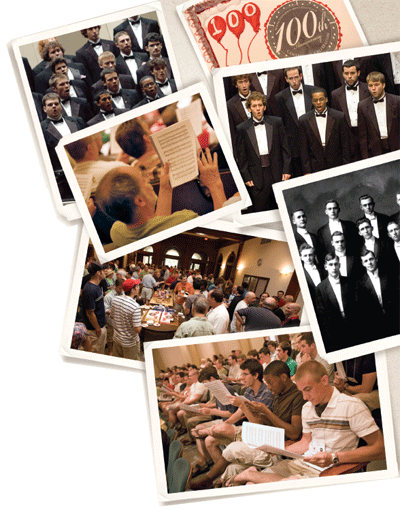
There are also the reunions, such as the 100th Anniversary Reunion Concert June 16, 2007, during Reunion Weekend. About 350 alumni rehearsed intensely and presented a challenging concert under the three living conductors, Sperry, Wabrick, and Clayton Parr (1989-98). For Wabrick, it was as if they had never left.
“I wasn’t worried. It’s that trust that you develop,” he says.
The ensemble has worked with countless luminaries. Last year Brubeck visited the campus to coach and perform.
“To have him there playing and improvising, to have that personal insight, just getting to know him and seeing his personality, that’s such a way of bringing music to life,” Sperry says.
But for conductors and singers alike, the inspiration is not in performing with celebrities. It comes from a higher plane.
“Making music with other people is one of those things that makes me truly believe we’re not alone. It may be religious or spiritual, but the belief that people are connected has happened to me more powerfully in choral pieces than anything else,” Sperry says.
Wabrick agrees.
“It’s the strength of it, it’s the warmth of it, it’s the joy of guys being together and of feeling good about what they do.”
Janelle Gelfand of Wyoming, Ohio, is classical music writer for The Cincinnati Enquirer.
Editor’s note: Glee does not refer to the mood of the music or its singers, but to a 17th and 18th century English style of song, the glee. Most clubs no longer perform glees, instead specializing in short songs.
The Miami Men’s Glee Club will perform its 100th Anniversary concerts Feb. 28-March 1, 2008. For details, go to the club’s Web site at www.mugleeclub.org/.
 Back to the Miamian Magazine Fall 2007 Web page Back to the Miamian Magazine Fall 2007 Web page
|