
Changing conversations: Tammy Kernodle helps shape the discussion around music
Miami Distinguished Professor of Music recently selected as Honorary Member of American Musicological Society
•
Published
•
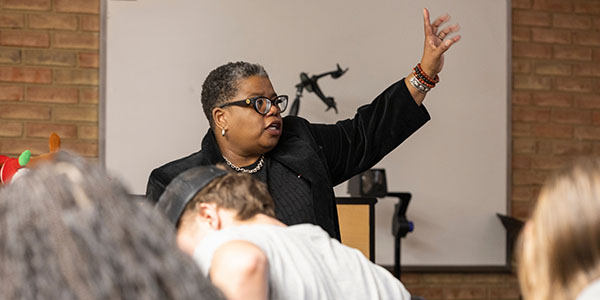
Miami University's Tammy Kernodle, Distinguished Professor of Music, recently was named an Honorary Member of the American Musicological Society. (Jeff Sabo photo)
Changing conversations: Tammy Kernodle helps shape the discussion around music
Miami Distinguished Professor of Music recently selected as Honorary Member of American Musicological Society
•
Published
•
For most of Tammy Kernodle’s youth, she was a serious student of piano.
Even when Kernodle enrolled at Virginia State University, her focus was still on one day becoming a concert pianist. That changed during her junior year, though, when Kernodle first read the book “Music of Black Americans: A History” by Eileen Southern.
Southern’s work helped shape the trajectory of Kernodle’s career, much in the same way the Distinguished Professor of Music at Miami University now helps shape the conversations — both in the classroom and out in the community — around music.
Kernodle was one of three recently selected as Honorary Members of the American Musicological Society (AMS). Learning she received the honor was “quite surreal,” Kernodle said. She first joined the society as a graduate student at Ohio State University but left because the focus of her work, American music and gender studies in music, was not as integrated into the fabric of the society at that time.
She was asked to return to AMS around 2008 when her former advisor, Charles Atkinson, became president. Kernodle found the society included more diverse perspectives on music and was acknowledging the work of emerging scholars in a way that was more representative to the evolving range of the discipline.
And it all started with Southern.
“I just didn’t know people did that kind of work,” Kernodle said. “From that point, I started researching and decided I wanted to do musicology. I wanted to be a Black music scholar, which was radical in 1991. To do those kinds of cultural studies and gender studies in music outside the field of ethnomusicology was unusual. Black music had to be a secondary area, not a primary area of specialty. I was determined it was going to be my primary area.”
Kernodle flourished in her career, developing into a prolific national voice in the discussion of music and appearing in pieces from NPR, CBS, the New York Times, and many other notable publications and outlets. She’s written for several peer-reviewed journals, penned the biography “Soul on Soul: The Life and Music of Mary Lou Williams,” and was an associate editor for the three-volume Encyclopedia of African American Music. She’s also contributed to the African American Lectionary Project, the Smithsonian Anthology of Hip Hop and Rap, the Smithsonian Anthology of Jazz, and the Carnegie Hall Digital Timeline of African American Music.
Just as important to Kernodle as her scholarly works? Her role in curating the New World Symphony’s annual “I Dream a World” festival, which celebrates its fifth edition this February in Miami, Florida.
When organizers first approached Kernodle about the festival, she thought it might be “one and done.”
“For it to blossom into this festival that just keeps growing and growing every year is exciting,” Kernodle said.
“I’ve never wanted to distance myself from the general public. If we only talk to a small group of people and utilize jargon that is discipline based, we are doing a disservice to the field of music studies. I’ve always wanted to produce work that speaks to both.”
More is on the horizon for Kernodle. She consulted on a PBS documentary on jazz legend Hazel Scott, “American Masters – The Disappearance of Miss Scott,” and is interested in doing similar projects. She’s also excited to continue to collaborate with Miami students, from teaching them how to write about music for the general public to the process for selecting music for a festival.
AMS lauded Kernodle’s efforts for enlarging and enriching the centrality of Black music in America, writing that Kernodle’s “public-facing work with museums, digital projects, and music organizations have allowed her to share her wisdom and knowledge with all kinds of people.”
Sharing that insight is important to Kernodle.
“I am reimagining what I do at Miami as a teacher,” she said.
“I embarked on a journey. My family didn’t understand what musicology was, didn’t understand why I was moving to Ohio where I knew no one. But I was determined. I wanted to write. I wanted to teach. I just wanted to change the conversations.”
Even when Kernodle enrolled at Virginia State University, her focus was still on one day becoming a concert pianist. That changed during her junior year, though, when Kernodle first read the book “Music of Black Americans: A History” by Eileen Southern.
Southern’s work helped shape the trajectory of Kernodle’s career, much in the same way the Distinguished Professor of Music at Miami University now helps shape the conversations — both in the classroom and out in the community — around music.
Kernodle was one of three recently selected as Honorary Members of the American Musicological Society (AMS). Learning she received the honor was “quite surreal,” Kernodle said. She first joined the society as a graduate student at Ohio State University but left because the focus of her work, American music and gender studies in music, was not as integrated into the fabric of the society at that time.
She was asked to return to AMS around 2008 when her former advisor, Charles Atkinson, became president. Kernodle found the society included more diverse perspectives on music and was acknowledging the work of emerging scholars in a way that was more representative to the evolving range of the discipline.
And it all started with Southern.
“I just didn’t know people did that kind of work,” Kernodle said. “From that point, I started researching and decided I wanted to do musicology. I wanted to be a Black music scholar, which was radical in 1991. To do those kinds of cultural studies and gender studies in music outside the field of ethnomusicology was unusual. Black music had to be a secondary area, not a primary area of specialty. I was determined it was going to be my primary area.”
Kernodle flourished in her career, developing into a prolific national voice in the discussion of music and appearing in pieces from NPR, CBS, the New York Times, and many other notable publications and outlets. She’s written for several peer-reviewed journals, penned the biography “Soul on Soul: The Life and Music of Mary Lou Williams,” and was an associate editor for the three-volume Encyclopedia of African American Music. She’s also contributed to the African American Lectionary Project, the Smithsonian Anthology of Hip Hop and Rap, the Smithsonian Anthology of Jazz, and the Carnegie Hall Digital Timeline of African American Music.
Just as important to Kernodle as her scholarly works? Her role in curating the New World Symphony’s annual “I Dream a World” festival, which celebrates its fifth edition this February in Miami, Florida.
When organizers first approached Kernodle about the festival, she thought it might be “one and done.”
“For it to blossom into this festival that just keeps growing and growing every year is exciting,” Kernodle said.
“I’ve never wanted to distance myself from the general public. If we only talk to a small group of people and utilize jargon that is discipline based, we are doing a disservice to the field of music studies. I’ve always wanted to produce work that speaks to both.”
More is on the horizon for Kernodle. She consulted on a PBS documentary on jazz legend Hazel Scott, “American Masters – The Disappearance of Miss Scott,” and is interested in doing similar projects. She’s also excited to continue to collaborate with Miami students, from teaching them how to write about music for the general public to the process for selecting music for a festival.
AMS lauded Kernodle’s efforts for enlarging and enriching the centrality of Black music in America, writing that Kernodle’s “public-facing work with museums, digital projects, and music organizations have allowed her to share her wisdom and knowledge with all kinds of people.”
Sharing that insight is important to Kernodle.
“I am reimagining what I do at Miami as a teacher,” she said.
“I embarked on a journey. My family didn’t understand what musicology was, didn’t understand why I was moving to Ohio where I knew no one. But I was determined. I wanted to write. I wanted to teach. I just wanted to change the conversations.”
Established in 1809, Miami University is located in Oxford, Ohio, with regional campuses in Hamilton and Middletown, a learning center in West Chester, and a European study center in Luxembourg. Interested in learning more about the College of Creative Arts? Visit the website for more information.