
Department of Engineering Technology professor honored for engineering education excellence
The Institute of Electrical and Electronics Engineers (IEEE) is the world’s largest technical professional organization dedicated to advancing technology for humanity
Department of Engineering Technology professor honored for engineering education excellence
The Institute of Electrical and Electronics Engineers (IEEE) is the world’s largest technical professional organization dedicated to advancing technology for humanity
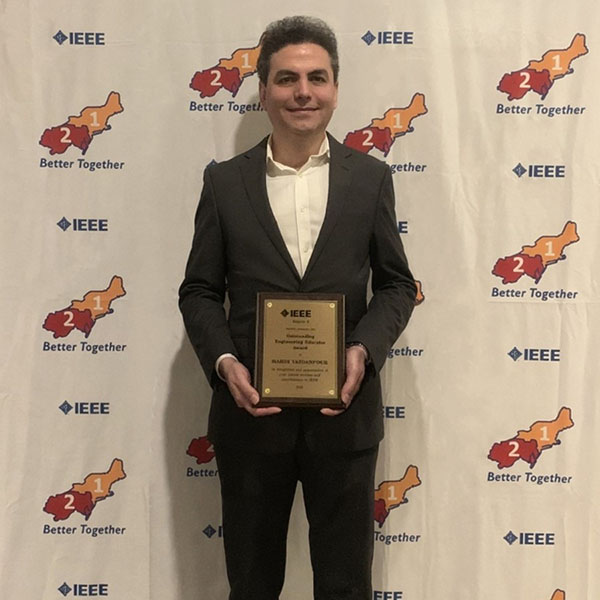
Mahdi Yazdanpour, associate professor in the Department of Engineering Technology, was recently awarded the IEEE Region 2 Outstanding Engineering Educator Award. This prestigious honor recognizes Yazdanpour’s excellence in engineering education. Region 2 includes 20 IEEE sections across the Mid-Atlantic and Ohio Valley region.
Yazdanpour began teaching at Miami University in fall 2025. Previously, he served as an assistant professor and program coordinator of Mechatronics Engineering Technology at Northern Kentucky University, bringing over a decade of industry experience to the classroom.
Alongside his professional experience, he brings a strong interdisciplinary background in engineering education to the department. He received his B.S. in Computer Engineering from Qazvin Azad University, his M.S. in Industrial Engineering from Amirkabir University of Technology (Tehran Polytechnic), and his Ph.D. in Electrical Engineering from Oklahoma State University.
“This diverse background has helped me look at engineering problems from multiple perspectives and approach teaching and research with a strong focus on practical, real-world solutions,” he said.
Yazdanpour is also an ABET Program Evaluator, helping evaluate engineering technology programs for quality, student learning outcomes, and continuous improvement — a role that supports his focus on industry-relevant engineering technology education.
In the classroom, Yazdanpour incorporates hands-on, student-centered learning into his curriculum to prepare students for the future. “This approach helps students prepare for real-world engineering problems that are multidisciplinary, open-ended, and require collaboration among different teams and individuals,” he said.
Since transitioning to academia, Yazdanpour has been inspired by student growth and committed to helping students build the skills and confidence needed to achieve their academic and professional goals.
“Many students begin a course or project with curiosity, but they may not yet have full confidence in their abilities,” Yazdanpour said. “Through mentorship, hands-on experience, and consistent practice, they begin to build confidence, technical independence, and the ability to solve complex problems.”
At Miami University, Yazdanpour hopes to contribute to a learning environment that values student success, applied learning, and innovation. He enjoys helping students connect classroom concepts to meaningful engineering applications, whether through senior design, laboratory work, research projects, or industry-relevant challenges.
Outside of the classroom, Yazdanpour’s research interests center on real-world applications, including intelligent mechatronic systems, human-robot interaction, artificial intelligence, brain-computer interfaces, brain-controlled systems, automation, and assistive technologies.
One of Yazdanpour’s current research projects is an AI-driven, hybrid brain-computer interface integrated with a brain-controlled prosthetic arm. The project has attracted attention beyond the laboratory, including coverage by local television channels and a feature in the O&P Almanac, a magazine published by the American Orthotic and Prosthetic Association. A patent application related to the technology has also been submitted. The project has also received research support and innovation recognition through competitive grant and award programs, further highlighting its translational potential.
“A long-term goal of mine is to contribute to technologies that improve quality of life, especially for individuals who may benefit from advanced engineering solutions that support health, independence, and daily living,” Yazdanpour said.
When conducting research projects, Yazdanpour is motivated by innovation and the opportunity to develop technologies that address real needs and open new possibilities. Yazdanpour is also motivated by students. He said, “Their questions, creativity, and persistence inspire me to keep improving my teaching, developing new projects, and pursuing research opportunities that support student involvement and professional growth.”
\When he received the Outstanding Engineering Educator Award, Yazdanpour was deeply moved, as it was a testament to his commitment to engineering education. His philosophy is that engineering education should prepare students for the real world while also building confidence and curiosity.
“My first reaction was gratitude — especially for my wife, who has been my main source of support, as well as for my students, colleagues, and mentors,” he said. “This award reflects the projects, partnerships, and support systems that have shaped my work as an educator and researcher.”
Yazdanpour hopes to continue developing a strong model of engineering technology education that integrates hands-on learning, undergraduate research, industry relevance, and emerging technologies at Miami University. He also hopes to continue his research in intelligent mechatronics, robotics, automation, and brain-controlled systems. Most importantly, he hopes to continue mentoring and supporting engineering students.
“For me, one of the greatest accomplishments is seeing students develop the confidence, skills, and sese of purpose to use engineering technology in ways that benefit industry, communities, and society,” he said.