
History professor shares Pompeii survivor research featured in docuseries
Inside the search for Pompeii’s survivors with Steven Tuck
•
Published
•
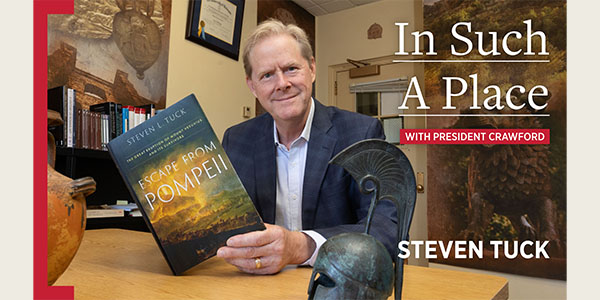
Steven Tuck, professor of History, appeared on the most recent "In Such a Place" podcast episode hosted by Miami University President Gregory Crawford.
History professor shares Pompeii survivor research featured in docuseries
Inside the search for Pompeii’s survivors with Steven Tuck
•
Published
•
Miami University History professor Steven Tuck has spent his career searching for the answer to one of history’s greatest mysteries. Now that question, and Tuck himself, are at the center of a National Geographic docuseries.
Once thought of as a total catastrophic loss, the eruption of Mount Vesuvius covered the city of Pompeii in layers of volcanic ash, immortalizing the moment of disaster. Tuck dared to question, “What if someone survived?” And, he was right. What began as a project to uncover the few, evolved into a hunt to trace an estimated 3,000 survivors by family name alone.
That one question has been on his mind since a trip to Cumae as an undergraduate student studying classical languages. His advisor posed his theory to the class: reconstruction of Cumae 15 years after the eruption may be evidence of Pompeii survivors.
“It never occurred to us that anybody had gotten out,” Tuck recalled. “I thought I would like to see if I can answer that question. So rather than just looking for buildings, I started looking for people.”
Why is this ancient mystery being uncovered over two millennia later? Tuck said the expansive research needed to track survivors down was unthinkable before digital databases, some of which he contributes his own time to expanding, updating and correcting.
“This project would not have been possible without technology,” Tuck said. “I looked at tens of thousands of Latin inscriptions online, one at a time, searching for survivors, searching for names, searching for people, and I couldn't have done that with the books.”
Tuck published his research last fall in his book “Escape from Pompeii: The Great Eruption of Mount Vesuvius and Its Survivors.” Now, his work is streaming on Disney+ and Hulu. The new docuseries “Pompeii: Out of Time,” hosted by Marvel actor Tom Hiddleston, explores the same question Tuck has spent his professional career investigating.
Tuck joins Hiddleston to explain how survivors are found and tracked into their new lives after the eruption of Mount Vesuvius, bringing him into the Pompeii Survivors Project.
“I looked at Pompeii and its sister city, Herculaneum, at records of names from essentially 15 years before the eruption. I decided if people were at one of those cities in the last years, and then I find them later on somewhere else, that's a survivor,” Tuck explained of his research process.
By tracing familial lines, Tuck found some survivors had fallen in status in their new lives, while others sought asylum in nearby communities and fully integrated into them. Tuck tells Pompeii survival stories of faith, resilience, and community, similar to those of modern-day refugees and natural disaster survivors.
Ultimately, Tuck’s research has uncovered thousands of survivors of the Pompeii tragedy, but his work is not yet finished.
“I think what's missing here are the people who moved in with other family members, which a lot of people do after natural disasters,” Tuck said. “So I think what I'm seeing actually is a minority.”
Tuck revealed more about the lives of those who escaped Pompeii when he sat down with Miami University President Gregory Crawford for the podcast, “In Such a Place.” Learn more and listen to the episode.
Once thought of as a total catastrophic loss, the eruption of Mount Vesuvius covered the city of Pompeii in layers of volcanic ash, immortalizing the moment of disaster. Tuck dared to question, “What if someone survived?” And, he was right. What began as a project to uncover the few, evolved into a hunt to trace an estimated 3,000 survivors by family name alone.
That one question has been on his mind since a trip to Cumae as an undergraduate student studying classical languages. His advisor posed his theory to the class: reconstruction of Cumae 15 years after the eruption may be evidence of Pompeii survivors.
“It never occurred to us that anybody had gotten out,” Tuck recalled. “I thought I would like to see if I can answer that question. So rather than just looking for buildings, I started looking for people.”
Why is this ancient mystery being uncovered over two millennia later? Tuck said the expansive research needed to track survivors down was unthinkable before digital databases, some of which he contributes his own time to expanding, updating and correcting.
“This project would not have been possible without technology,” Tuck said. “I looked at tens of thousands of Latin inscriptions online, one at a time, searching for survivors, searching for names, searching for people, and I couldn't have done that with the books.”
Tuck published his research last fall in his book “Escape from Pompeii: The Great Eruption of Mount Vesuvius and Its Survivors.” Now, his work is streaming on Disney+ and Hulu. The new docuseries “Pompeii: Out of Time,” hosted by Marvel actor Tom Hiddleston, explores the same question Tuck has spent his professional career investigating.
Tuck joins Hiddleston to explain how survivors are found and tracked into their new lives after the eruption of Mount Vesuvius, bringing him into the Pompeii Survivors Project.
“I looked at Pompeii and its sister city, Herculaneum, at records of names from essentially 15 years before the eruption. I decided if people were at one of those cities in the last years, and then I find them later on somewhere else, that's a survivor,” Tuck explained of his research process.
By tracing familial lines, Tuck found some survivors had fallen in status in their new lives, while others sought asylum in nearby communities and fully integrated into them. Tuck tells Pompeii survival stories of faith, resilience, and community, similar to those of modern-day refugees and natural disaster survivors.
Ultimately, Tuck’s research has uncovered thousands of survivors of the Pompeii tragedy, but his work is not yet finished.
“I think what's missing here are the people who moved in with other family members, which a lot of people do after natural disasters,” Tuck said. “So I think what I'm seeing actually is a minority.”
Tuck revealed more about the lives of those who escaped Pompeii when he sat down with Miami University President Gregory Crawford for the podcast, “In Such a Place.” Learn more and listen to the episode.
Established in 1809, Miami University is located in Oxford, Ohio, with regional campuses in Hamilton and Middletown, a learning center in West Chester, and a European study center in Luxembourg.