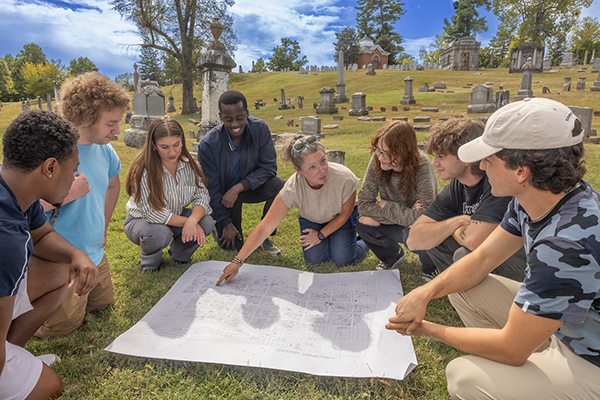
Purposeful networking leads to outstanding opportunities for Miami geography students
The GIS certificate is available to everyone, regardless of majors, and opens real-world doors
Purposeful networking leads to outstanding opportunities for Miami geography students
The GIS certificate is available to everyone, regardless of majors, and opens real-world doors
Robbyn Abbitt’s 20-plus years in Miami University’s Department of Geography has seen evolutions of all kinds, ranging from staff size to students’ innate abilities to utilize drones.
The one constant?
“Success is very rarely because you did something on your own,” she says. “It’s about the people that you gathered around and the connections you’ve made. I’ve been very purposeful in the 21 years I’ve been here to actively build a network.”
Abbitt, GIS coordinator and associate director of the Geospatial Analysis Center, looked to connect with other geographic information systems (GIS) professionals when she first arrived at Miami
“I needed to understand what the GIS landscape was in Ohio in order to be successful in the classroom,” she said. “What it has pivoted to is open doors for students, because I give them full access to my network connection, and the people who are in my network know that I’m pushing students out to them as well. It’s totally a win-win.”
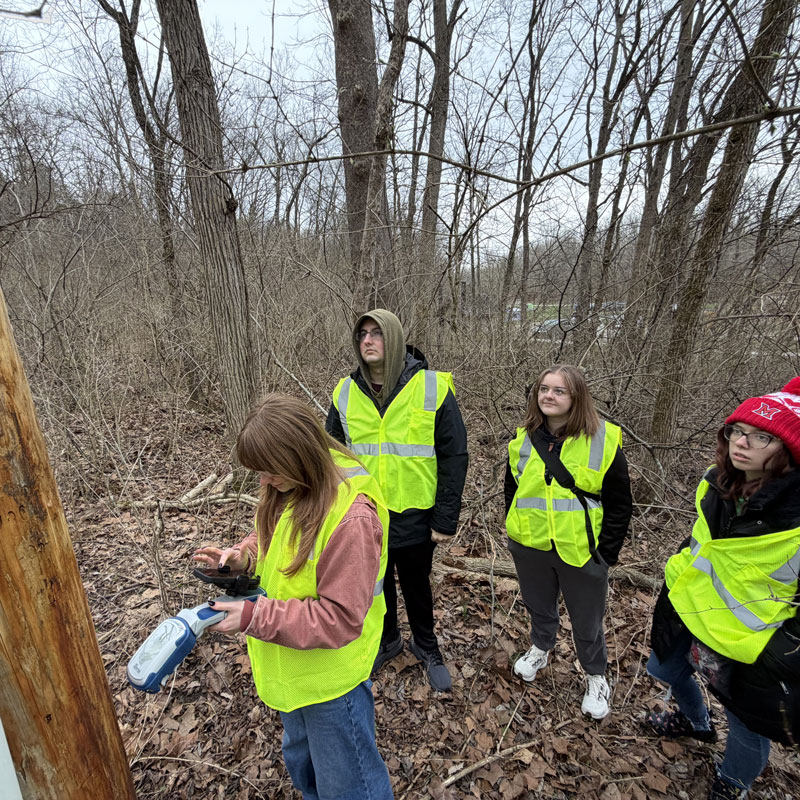
Students take the reins in Butler County
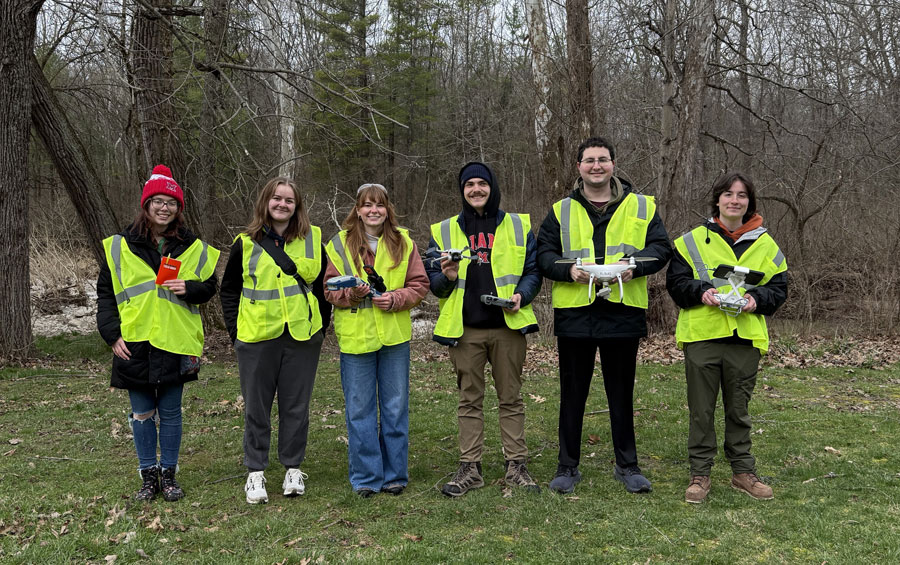
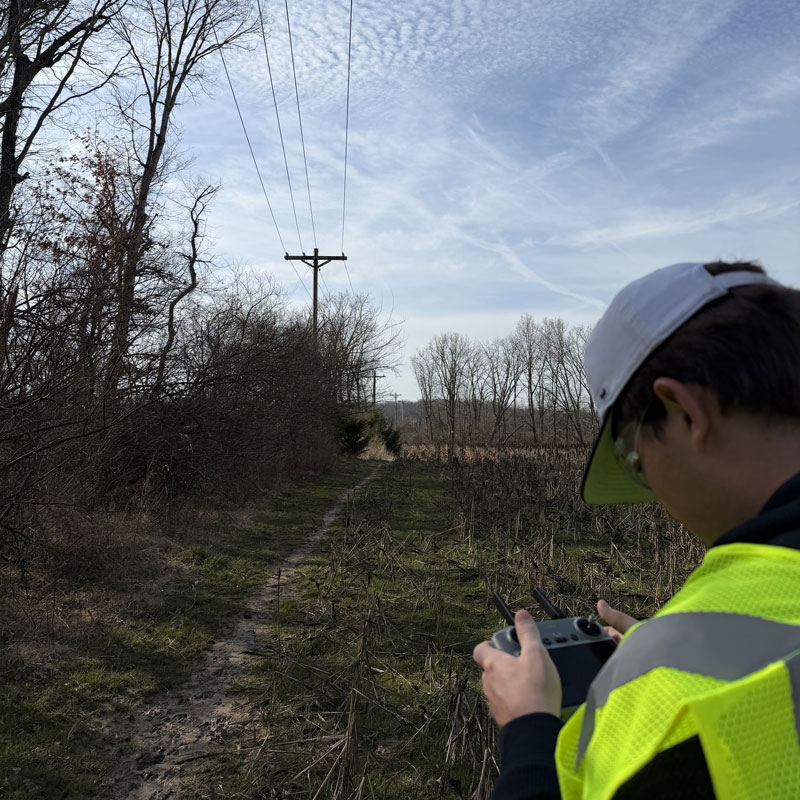
The aforementioned networking initiative reached new heights this past semester, with the Butler Rural Electric Cooperative’s engineering department. Abbitt’s students brought their drone expertise to help map utility right-of-way methods, which ranged from overhead-to-underground wire feasibility to finding utility poles that were in need of repair.
The project was two decades in the making. Abbitt’s early days at Miami included meeting recent geography graduate Andrew Wilson ‘04, at the time working with the City of Oxford. Years later, he connected Abbitt with Joshua Smock, now the GIS and engineering specialist for Butler Rural Electric Cooperative.
The Cooperative featured the exhaustive class project in its August edition (“Powering Education”) including that “the partnership demonstrated that drone-assisted inspections could be practical and effective for future in-house operations.”
Not only did that experience help both parties, no households lost power in the process. That’s savvy.
Samantha Besel, senior Zoology major and combined master’s student in Environmental Science, as well as an Honors College member, is obtaining a GIS master’s certificate with Abbitt. Besel said she always wanted to work in conservation, but this new exposure modified her outlook.
“GIS has been heavily used in conservation work, which is where I still want to work, but now I’m focused not just on animals, but also plant life and the entire habitat in general,” she said. “Before this program, I wasn’t very aware of how GIS is used, and I think after I’ve taken two courses on it, I’ve gained a larger appreciation.
“Even to this day, people ask me what my certificate is, and they are surprised to see how much it’s incorporated into different jobs.”
Bringing it all back home
The 2025-2026 academic year was the first in which a drone training class was offered, and Abbitt said the one-credit-hour course was meant to help students obtain their Part 107 (FAA Remote Pilot Certificate) license. While that part is not required when flying on campus and alongside the licensed faculty, it is once again about preparing for the future.
“The students are going to learn about how drones are used in real estate, agriculture, fire and EMS,” Abbitt said. “They understand once they’re done with school that it can be a job or part of one. Is your $200 for the license exam gone, or is it used as an additional piece of information to level you up against peers in the job market?”
Abbitt also cited Miami’s ASPIRE (Advancing State Priorities, Igniting Regional Economies) office andthe university’s Advanced Air Mobility initiative as contributors to her students’ success.
The number one takeaway from all of this?
“Anybody at Miami can add the GIS certificate at the undergrad or graduate level and add that skill set to their time here,” Abbitt said. “(Employers) know that when a Miami GIS student comes in, a) they’re going to be a great colleague, and b) they have fundamentals, know how to ask questions and are very teachable.”